

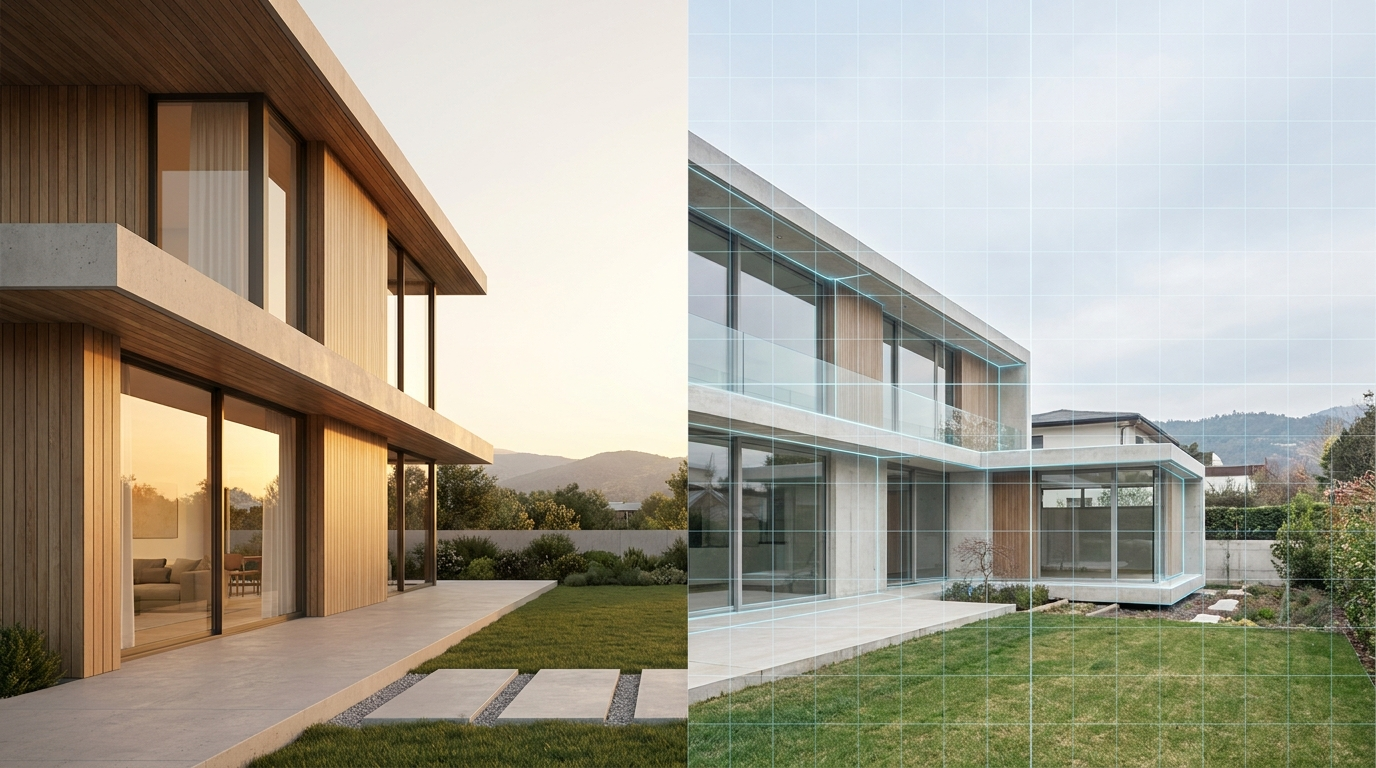
Property marketing just picked up a legal problem it didn't have a year ago.
California's AB 723, in force since January 2026, makes it a misdemeanour to publish a real estate listing photo altered by AI without disclosing it — and sellers can be required to produce the unedited original on request. It's aimed at listing photos where a saggy roofline gets straightened, a patchy lawn goes emerald, or a poky room gets AI-widened before it ever reaches a buyer's screen.
The UK hasn't passed an equivalent law. But the direction of travel is obvious. Rightmove and Zoopla have both tightened photo-accuracy guidance in the past two years, the Advertising Standards Authority already polices misleading property imagery under existing consumer protection rules, and RICS valuation standards are explicit that marketing material shouldn't misrepresent a property's condition. A written disclosure requirement isn't a big legislative leap from where the UK already sits — it's a matter of when, not if, someone tables it.
What this actually means for anyone marketing a development
If your current visual pipeline is "take photos, then retouch heavily," AB 723 — and whatever version of it eventually lands in the UK — puts you in a position where you either disclose every touch-up or risk exactly the kind of "misleading buyer" complaint that regulators are already primed to act on. For estate agents and small developers relying on smartphone photography plus AI cleanup apps, that's a real compliance headache: proving what counts as "AI-altered" versus routine colour correction is genuinely murky, and murky is expensive when a regulator or an unhappy buyer decides to test it.
For anyone marketing new-build or off-plan property, though, there's a cleaner way through this that most developers haven't clocked yet.
CGI doesn't have a disclosure problem — because it was never a photograph
Architectural visualization isn't an edited photo of a real thing. It's a rendered representation, and it's always been presented as one. There's no "original" to withhold, no retouching to disclose, no borderline case about how much correction is too much. A CGI render of a development that's still under construction, or a product visual for an item still in tooling, is explicit about what it is from the outset — which is exactly the transparency regulators are trying to force photography into after the fact.
That's not a reason to panic-switch every marketing asset to CGI. Photography still does things CGI can't — it proves a property exists, in its actual current state, which matters at the point of sale. But for anything being marketed before completion, or where the "after" state doesn't exist yet to photograph, CGI was already the more honest tool. AB 723 just makes that advantage legally relevant instead of merely practical.
The practical takeaway
If you're a developer or marketing agency currently leaning on AI-retouched photography to sell units that aren't finished yet, this is worth a five-minute conversation with whoever handles your visual marketing: which of your current assets are photographs standing in for CGI's job, and would an actual render remove the disclosure question rather than just delaying it. Given the UK's regulatory direction, that's a cheaper fix now than a compliance scramble later.
