

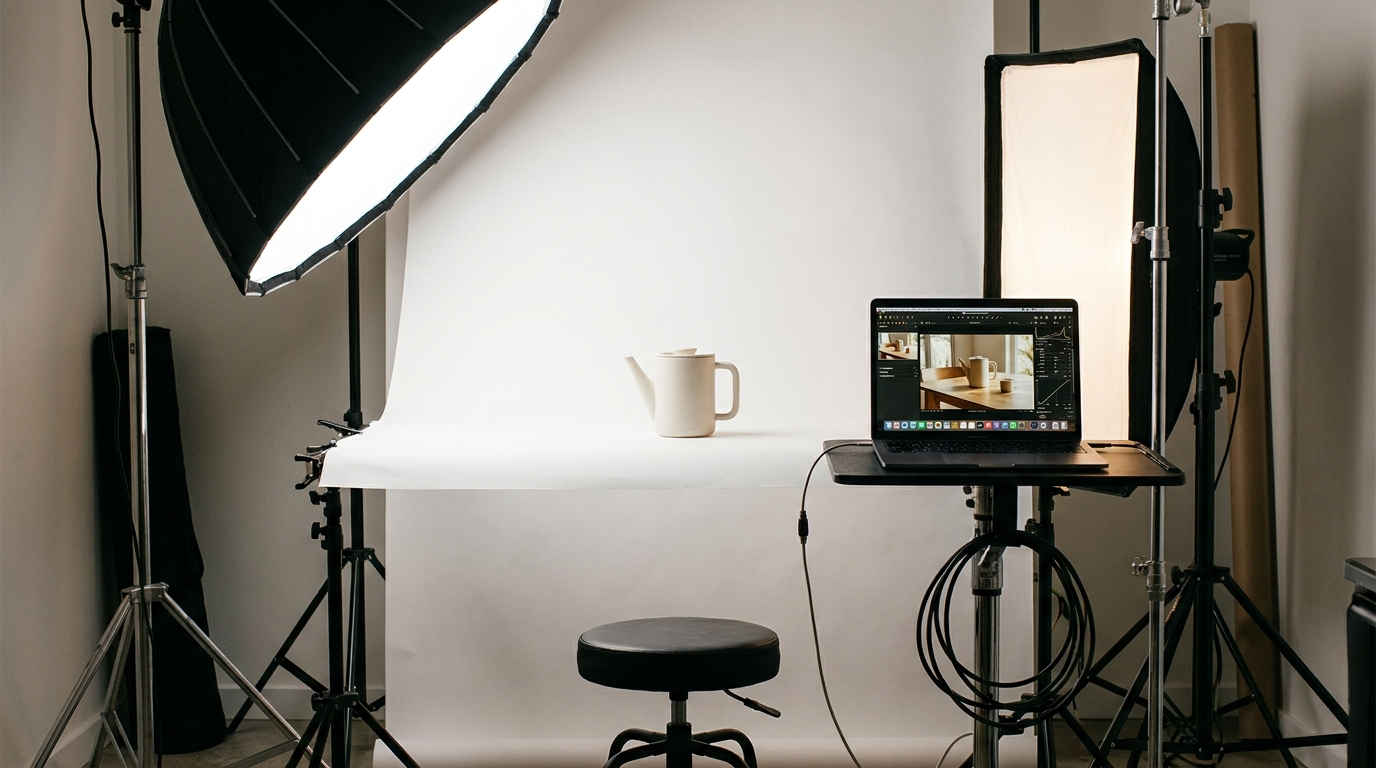
A UK product photography studio settled the AI-versus-real argument with an actual test this year: one cream kettle, shot both ways. The result says a lot about where product visuals are actually heading in 2026.
The Kettle Test That Settled the Argument
Photograph My Product, a studio based in York, ran the AI-versus-real debate through an actual test this year: one cream kettle, shot both ways. A phone photo went into an AI tool and came out as a slick lifestyle scene in minutes. At thumbnail size it looked commercial. Zoomed in, the handle, the chrome reflections and the surface where the kettle meets the counter all started to drift from the real product.
Where AI-Only Workflows Fall Apart
One AI image is easy. Forty matching SKUs is where it breaks. Handles change shape between images, chrome reflections stop agreeing with each other, packaging proportions drift, and colour moves away from the real product. Individually these look minor. Across a catalogue they read as a brand that doesn't have its imagery under control, and that's exactly what pushes returns up and reviews down. Cost is why brands are tempted to go all-in on AI anyway: a 20-product studio shoot can run $2,200 to $6,200 in photographer time, studio hire, styling and editing, against roughly $100 to $300 for an AI-generated set covering the same range. That gap is real. The argument isn't whether to use AI, it's where it belongs in the workflow.
The Anchor of Truth
The workflow winning in 2026 isn't AI or photography, it's photography first, AI after. Shoot the product once, properly, under controlled lighting, with reflections, colour and proportions physically correct. That becomes the anchor. Every other image, lifestyle, seasonal, social, campaign extensions, gets built from that anchor using AI-assisted compositing rather than a fresh shoot each time. PMP calls their version Digital Composite Lifestyle: real studio capture, commercial retouch, then a digitally built scene around it, with every output checked back against the original packshot for colour, scale and lighting direction before it ships. That QA step is the one AI-only pipelines almost always skip, and it's the difference between one striking image and a catalogue that actually holds together.
What This Means for Your Next Brief
If you're a product designer or property developer commissioning visuals right now, don't brief "AI images" or "a full shoot" as a binary choice. Brief one accurate, properly lit reference capture, whether that's photography or CGI, and use that as the fixed asset every downstream image gets built from. It's faster than a full location shoot for every variant, and it keeps the product honest, which is what actually protects conversion and return rates once customers start zooming in.
Quick Answers
What is a hybrid AI and photography workflow?
It means capturing the product accurately once, whether by photography or CGI, then using AI to build lifestyle scenes, seasonal variants and campaign extensions around that single verified image, instead of generating or reshooting every version from scratch.
Does AI product photography work for marketplace listings like Amazon?
For supporting and lifestyle images, generally yes. For the main hero image, most studios still recommend a real, compliant photograph, because shoppers zoom in and marketplaces expect an accurate representation of the actual product.
Why does AI-generated product imagery look inconsistent across a range?
Most AI tools regenerate the product slightly differently each time, so handle shape, reflections and colour drift between images. A hybrid workflow avoids this because the product is captured once and reused as the fixed reference for every variant.
Is this relevant to CGI as well as photography?
Yes. The same principle applies to CGI-led product and architectural visuals: an accurate, properly lit base render or photograph should anchor any AI-generated variation, not the other way around.
