

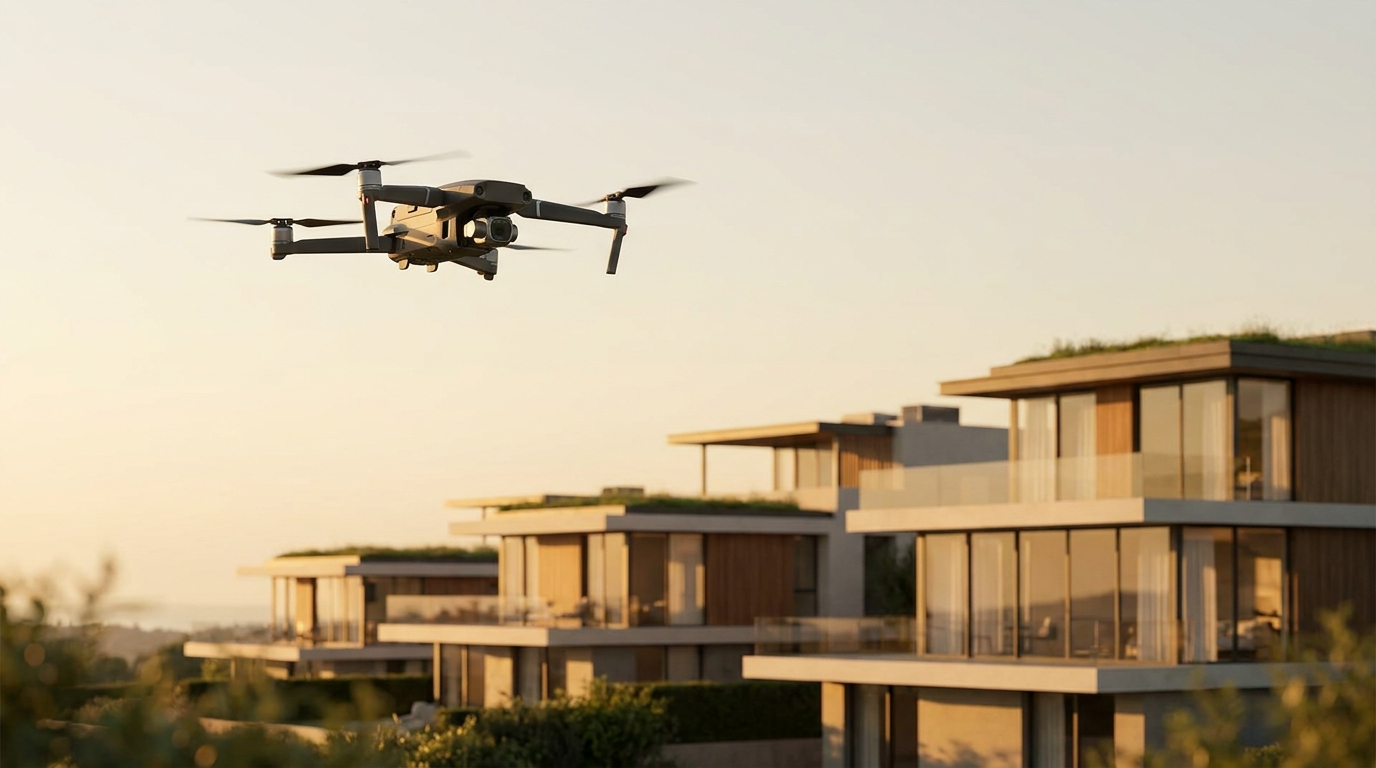
If you've commissioned aerial photography for a development or a product shoot in the last few years, the rules your supplier is operating under changed in January 2026 — and most marketing teams haven't noticed, because it's not their job to track CAA regulation. It's the supplier's. But if the supplier isn't compliant, the liability doesn't stay with them.
What actually changed on 1 January 2026
Three things shifted at once.
The registration threshold dropped. Previously, a Flyer ID was only required above 250g. Now, anyone flying a drone or model aircraft weighing 100g or more needs one — a free online theory test, valid for five years (CAA, Get a Flyer ID). Any drone with a camera at 100g or above — and any drone at all above 250g — also needs an Operator ID, which costs £12.34 and renews annually (CAA, Get an Operator ID).
Remote ID became mandatory for new UK-class-marked drones (UK1, UK2, UK3, UK5, UK6) from 1 January 2026. It broadcasts the drone's location, serial number and Operator ID — a digital number plate, readable by the CAA and police on the ground (CAA, Remote ID). Legacy drones bought before the new class-mark system have a grace period to 2028, but that's a retrofit cost some operators haven't budgeted for.
And for anything flown at night, a green flashing light is now required so the drone reads as unmanned aircraft, not a light aircraft (Coptrz, 2026 regulation changes).
Why this matters if you're commissioning, not flying
None of this requires you to personally learn drone law. It requires you to ask your photographer or CGI supplier three questions before you sign off a shoot: do you hold a current Operator ID, is your equipment Remote ID compliant or inside the legacy grace period, and can you show me your insurance certificate.
That last one is the one people skip, because "the photographer's got it covered" is usually said with more confidence than evidence behind it.
The insurance gap nobody checks
Commercial drone use — any flight where money changes hands, including a paid marketing shoot — legally requires third-party liability insurance under the Civil Aviation (Insurance) Regulations 2005 (CAA, Insurance requirements). A single freelance operator running a compliant annual policy is typically paying low-to-mid hundreds of pounds a year; a multi-drone operation runs into four figures (Impact Aerial, 2026).
If a supplier is cheap enough to undercut everyone else on a development shoot, ask why. Uninsured commercial drone work is a criminal offence, not just a contractual risk — and if something goes wrong over a live construction site or a crowded show-home weekend, "my supplier didn't have cover" is not a sentence you want to be saying to a client or an insurer.
For anything beyond simple visual-line-of-sight flying — closer to buildings, over people, at night — operators also need a General Visual Line of Sight Certificate (GVC) and a CAA Operational Authorisation specific to what they're doing (UAVMODEL Insights, 2026). Ask for that too if the shoot involves anything more than an open field.
What to ask before you book
Three questions, before the invoice, not after the shoot:
Do you hold a valid Operator ID and can you show it. Is your fleet Remote ID compliant, or still inside the 2028 legacy window and if so what's the plan. Can you send your current third-party liability insurance certificate and, if the shoot needs it, your GVC and Operational Authorisation.
Any supplier worth using will have these answers ready. If they hesitate, that's your answer.
Frequently Asked Questions
Does this affect photography for a show home or completed development, not just construction sites?
Yes. The rules apply to any commercial drone flight regardless of what's being filmed — marketing photography for a finished development is treated the same as a construction survey.
Do I need to check this myself, or is it the photographer's responsibility?
Legally it's the operator's responsibility to be compliant. Practically, if they're not and something goes wrong, you as the commissioning client can still face reputational and contractual fallout — so it's worth five minutes of checking upfront.
What's the cost impact for developers commissioning aerial shoots?
Compliant suppliers may charge slightly more to cover insurance and certification costs. Treat a noticeably cheap quote as a reason to ask more questions, not fewer.
Does this apply to indoor drone photography, e.g. inside a large showroom?
The Flyer ID, Operator ID and insurance requirements apply regardless of indoor or outdoor use if the drone is 100g+ and being flown commercially. Remote ID requirements are primarily aimed at outdoor/airspace tracking.
